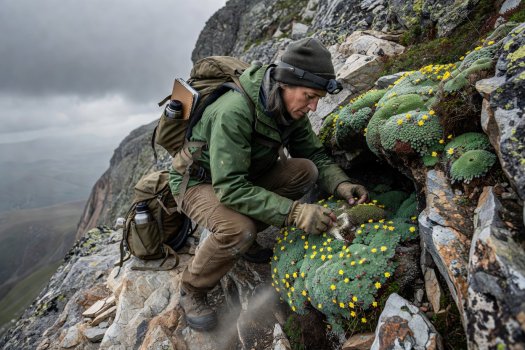
Saxifraga and Androsace: The High Alpine Specialist Guild
True alpines live in the harsh ecological bracket above tree line, where the growing season spans barely eight to ten weeks. Their compact anatomy and silver mineral armor represent pure evolutionary refinement.
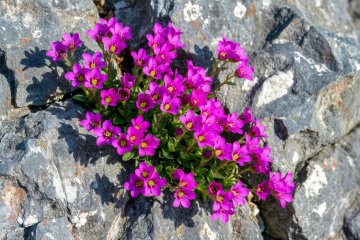
Saxifraga oppositifolia
The Purple Mountain Saxifrage is an Arctic-alpine survivor found on scree ridges up to 4,000m. Its opposing scale-like leaves feature mineral hydathodes that excrete chalky carbonates. Blooms appear immediately following snowmelt in late winter.
Preferred Substrate: Cool Limestone Fissures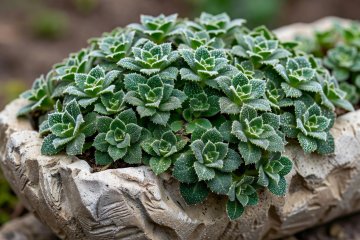
Saxifraga marginata
Hailing from the Apennines and Balkans, this silver-beaded cushion plant forms rigid domes of rosettes with distinct lime-pits along leaf margins. Flowers are glistening white on short, sturdy glandular stems.
Preferred Substrate: Calcareous Tufa Crevices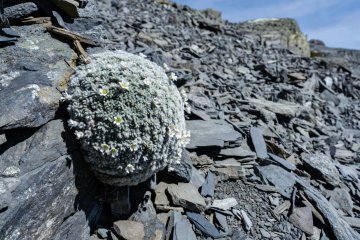
Androsace helvetica
The definitive rock-jasmine. Forms extraordinarily dense, hemispherical cushions covered in minute stellate hairs. Demands strictly vertical crevice installation with zero direct winter moisture to prevent rot inside the cushion core.
Preferred Substrate: Vertical Sandstone FissureAnatomy of the High-Elevation Cushion
Why do mountain plants grow as compact hemispherical domes? Inside the tight canopy of a healthy Draba or Androsace, wind velocity drops to zero. Dead leaves do not fall away; they decompose into a spongy peat internal insulation core that moderates freezing temperatures.
In lowland cultivation, however, this dense cushion becomes a liability if wet winter air penetrates the interior. Moisture cannot evaporate, and Botrytis fungal mycelium rapidly consumes the cushion from within. Lowland growers must keep the air moving and the foliage dry.